
Case prepared by: Kiruthika
HOW TO DIAGNOSE CERVICAL RADICULOPATHY ACCURATELY?
Patient Profile:
- Age and gender: 25-year-old male
- Occupation: Government exam aspirant
- Complaint: Left side Neck & forearm pain for the past 3 months.
HISTORY:
About 3 months ago, he gradually started developing pain in his neck. He is a government exam aspirant, so he spends long hours sitting, reading, and writing. Initially, he ignored the pain, thinking it was due to prolonged sitting or poor posture.
Over time, the pain worsened and started radiating into his left arm, especially into the upper part of his forearm. The pain became severe, and he found it difficult to move his neck. This increased fear about the condition.
As he has left arm & forearm pain, he underwent multiple investigations — X-ray, ECG, and Echo — to rule out any cardiac issues. He then consulted several orthopaedic doctors, who advised him to take an MRI. The MRI revealed a cervical disc bulge. The doctors suggested an anterior cervical discectomy and fusion surgery. However, the thought of undergoing such a complicated surgery at this age made him very anxious and fearful.
He tried physiotherapy treatments, including cervical traction, but that actually worsened his pain and increased his fear (especially of the traction machine). He also received a steroid injection, which provided partial pain relief. Still, he is unable to sit or move his neck comfortably, which affects his exam preparation.
Past medical/surgical history:
No relevant medical history related to the current complaints
Physical activity status:
His physical activity level is very poor. Due to the doctor’s advice and his fear, he completely restricted even his everyday ADL activities for the past 3 months. He spends most of his time in bed rest
Sleep:
Poor, due to pain & worrying about his future.
Stress:
High stress, because of unemployment & severe pain
PAIN ANALYSIS:
| Parameter | Details |
|---|---|
| Intensity | 7/10 |
| Onset | Gradual |
| Aggravating Factors | Neck movements, lying on the left side, wearing helmet, lifting weights in the left forearm |
| Relieving Factors | Rest and left arm shoulder abduction |
| Location | Left side upper trapezius & left lateral part of forearm |
| Duration | Chronic – 3 months |
| Lifestyle Impact | High impact. He avoided all general physical activities. |
| Fear of Movement Analysis | Doctor/therapist-induced fear; pain and movement-related fear are present. |
Psychosocial factor analysis:
- Cognitive – He had a lot of negative beliefs regarding his pain, posture and movements
- Affective -The pain is causing emotional distress and worry.
- Social – family members are influencing him negatively, so that he needs surgery for his pain relief.
Our understanding of the patient's problem from history and pain analysis:
He has unilateral neck pain that is also radiating in the forearm. So it increases suspicion towards cervical radicular syndrome. But he is psychologically affected a lot because of this pain, so we need to diagnose accurately by ruling out every possible pathology with a physical examination.
PHYSICAL EXAMINATION:
He has unilateral neck pain that is also radiating in the forearm. So it increases suspicion towards cervical radicular syndrome. But he is psychologically affected a lot because of this pain, so we need to diagnose accurately by ruling out every possible pathology with a physical examination.
Observational findings: Nil
ROM analysis
- Cervical spine active ROM was globally reduced in all directions.
- Cervical movements, especially flexion & extension, elicited severe neck pain along with left-sided radiating pain into the entire upper limb.
Stability screening
- The strength of the shoulder flexors,shoulder abductors, & shoulder external rotators was checked by a break test. Left shoulder muscles showed reduction in strength.
- Grip strength also reduced in the left hand
Our understanding – Severe pain and global restriction of cervical ROM with associated left-sided radiating pain during neck movements strongly suggest cervical nerve root involvement. The presence of left shoulder muscle weakness further supports the possibility of neurological compromise rather than isolated musculoskeletal pain. But further assessments are required to confirm it.
Palpation:
The right upper trapezius, the upper part of the arm, and the forearm are painful.
Special tests:
- Spurling’s Test (Foraminal Compression): Positive on the left side
- Bakody’s Sign (Shoulder Abduction Relief Test): Positive
- Upper Limb Tension Test (ULTT): Positive on the left side
Cervical distraction test – Positive.
INVESTIGATION:
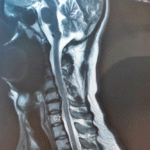
- MRI taken.
- Posterior disc bulge at the C5-C6 level, causing left neural compression.
DIFFERENTIAL DIAGNOSIS
Cervical myelopathy
In myelopathy, there will be bilateral neurological symptoms in both upper and lower limbs, along with a loss of fine motor functions of the hand & proper gait pattern. But the person does not have any of these symptoms.
Rotator cuff-related neck pain
Rotator cuff muscle weakness is present, but the person is also having radiating symptoms, so it denotes the neurological compression in the cervical spine.
Cervical spine stenosis
In stenosis, the entire spinal cord is compressed, so bilateral neurological symptoms will be present. But the person has only the left side radiating pain.
Spondylolisthesis of the cervical spine
There is no history of trauma, and also, there is no impression of listhesis on MRI.
DIAGNOSIS:
The possible diagnosis is Left-sided Cervical Radiculopathy
Reasons:
- Presence of unilateral radiating pain from the neck to the left upper limb
- Neck movements aggravate both local neck pain and radiating forearm pain
- Pain in the forearm is more severe than neck pain
- Motor weakness is present in the left upper limb, along with reduced grip strength on the left side
- Shoulder abduction relieves the radicular pain and neurological symptoms
- All cervical spine provocation tests are positive for cervical radiculopathy.
- MRI confirms disc bulge with corresponding nerve root compression
- Other differential diagnoses were properly evaluated and ruled out
TREATMENT PLANNING:
1. Patient’s Belief and Expectations
The patient’s primary expectation is to return to his routine life and work without symptom provocation.
2. Overall Treatment Strategy
Since it is a cervical radiculopathy with motor and sensory involvement generally requires at least 3-months of rehabilitation.
A total of 24 physiotherapy sessions were planned:
- Month 1: 3 sessions per week → 12 sessions
- Month 2: 2 sessions per week → 8 sessions
Month 3: 1 session per week → 4 sessions
3. Key Things to Focus on During Treatment
- Reducing fear-avoidance, neck pain and radicular symptoms
- Improving cervical mobility, strength of neck and upper limb muscles and enhancing neural mobility
- Restoring his daily life activities & preparing the patient for long-term self-management
Month 1 plan:
- Patient education for reducing his fear and improving confidence
- Breathing exercises for relaxation and symptom management
- Cervical isometric exercises & Upper-limb nerve gliding
- Chin tucks for the foraminal opening.
- Gentle active neck movements
- Neck stretches, thoracic mobility exercises and eccentric exercises for neck and shoulder muscles to improve mobility.
- Encouraging Shoulder strengthening (push, pull, raise movements)
Month 2 plan:
- Progressing the cervical & shoulder strengthening exercises according to his capacity.
- Encouraging Cardiovascular training based on his tolerance to improve his general physical health & fitness
- Inclusion of lower limb strengthening to improve overall conditioning
- More focus on home programs to encourage self-management.
Month 3 plan:
- Advising on preventing recurrence & self-management.
- Explained clearly regarding Load management – advised to listen to the body & progressively overload the exercises every time.
- Strength & conditioning guidance provided – about Proper workout plan & how to do progression and Regression & RPE scales to achieve a better outcome in strength and fitness.