
Case prepared by: Rakesh
Not All Bulges Hurt: A Case of Non-Specific Low Back Pain
PATIENT PROFILE
Age & Gender: 35-year-old male
Occupation: Auditor
Chief Complaint: Left-sided low back pain
HISTORY
Two years ago, the patient developed low back pain when his 3-year-old child suddenly jumped on his back while playing. The pain started immediately after that incident. Initially, he underwent physiotherapy for 1 month, but he did not experience any significant improvement. Later, he took an MRI, which showed normal findings. So the doctor advised him to continue exercising. The patient performed exercises for around 8 months, but he still reported persistent pain that had not improved. Then he sought a second medical opinion and repeated the MRI. The second MRI showed disc bulging, which made him upset.
After that, he underwent the Siddha treatment approaches and experienced about 50% improvement. Despite partial improvement, he continued to experience pain and fear of performing movements. Over time, the pain has continued, so this has affected his regular daily activities, and he has begun to reduce his physical activity levels. Eventually, the condition progressed to a stage where he was unable to perform even his normal office work comfortably.
Later, after watching our physiotherapy educational videos on Instagram, he decided to consult us for further treatment. During the consultation, the patient expressed the following objectives:
- To become pain-free,
- To return to all regular daily activities without discomfort,
- To resume work-related activities normally
Past Medical / Surgical History
No significant past medical or surgical history related to the current complaint.
Physical activity status:
Physical activity level is poor since the patient reduced activities due to advice from Doctors for the past 1 year.
Sleep:
Poor sleep due to pain; He sleeps only for 5 hours/day.
Stress:
High stress because of recurrent pain and not being able to do regular work.
PAIN ANALYSIS
Intensity: 7/10 (NPRS)
Onset: Sudden onset (after the child jumped on the back)
Aggravating factors: Travelling, forward bending (lumbar flexion), and daily activity
Relieving factors: Rest
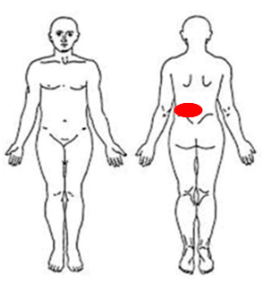
Location: Left side, low back, above PSIS
Duration: 2 years
Lifestyle impact: High; the patient reduced many daily activities.
Fear of Movement Analysis: The patient shows high fear of movement (kinesiophobia). He avoids bending and other activities because he believes the disc bulge may worsen with movement.
Psychosocial Factor Analysis
Cognitive: Patient strongly believes that the disc bulge seen in the MRI is the main cause of his pain.
Affective: Patient feels frustrated because he tried multiple treatments but did not fully recover.
Social: Social support from family is good.
Our understanding of patients' problems:
Since the back pain is associated with a sudden onset of a traumatic incident, it indicates the presence of any specific spinal pathology. But the patient’s overall lifestyle shows that his physical activity is poor, psychologically affected and has fear avoidance behaviour, which can be a major contributing factor for pain also. So we have to thoroughly assess to confirm whether it is a specific spinal pathology or a non-specific low pain
PHYSICAL EXAMINATION:
Observational findings:
Nil
Palpation:
No pain on palpation over the low back, hip and thigh: Normal
Mobility screening:
Forward bending movement quality is poor. The patient demonstrated a high fear of movement. During assessment, lumbar flexion was limited. When the patient attempted to bend forward, pain was triggered at approximately 50% of the lumbar flexion range.
Overhead squat – good (no shifts).
Stability screening
Break test for lower limb muscles showed no significant difference between the right & left side muscles.
ROM analysis
There is no significant difference between right and left in Hip, knee and ankle Range of motion.
Sensory examination:
Intact, there are no sensory disturbances
Special test analysis
SLR- Negative
Cross SLR- negative
Slump-negative
Investigation:
First MRI- normal
Blood test – ESR – CRP Normal
Second MRI: Mild central – Left paracentral extrusion of disc material at L5, S1 level
Differential Diagnosis
The following differential diagnoses were considered but ruled out based on the reasoning outlined below:
1) Lumbar Fracture / Dislocation
- He had a traumatic injury, but X-ray and MRI show normal. No impression of fracture/ dislocation
- No severe localised tenderness
2) Ankylosing spondylitis
- We suspected ankylosing spondylitis because he is having chronic pain & young age.
- But the other clinical features did not match,
- No early morning stiffness for more than 30 minutes
- Pain is not relieved by movement & rest does not aggravate it
- MRI also normal – there are no impressions of sacroiliitis
- ESR and CRP are normal
3) Radicular syndrome
- Since it’s unilateral pain, we need to suspect lumbar radicular pain/radiculopathy.
- But no pain during coughing & sneezing
- No radiating pain, tingling/numbness sensation in the lower limb
- SLR, Cross SLR & slump are Negative, not reproducing pain
- No significant motor loss/ muscle weakness.
- There are no bilateral symptoms, so we can also rule out lumbar canal stenosis, radicular pain and radiculopathy.
4) Myelopathy
- No bilateral neurological symptoms or neurological deficits
- There is no bowel or bladder dysfunction, & Gait disturbance
Possible Diagnosis
Non-Specific Low Back Pain (NSLBP)
Reasons:
- MRI of the spine was normal, ruling out structural abnormalities. No red flag signs were present.
- Inflammatory blood markers were within normal limits, excluding systemic/infective/ inflammatory conditions.
- Radicular syndrome was clinically assessed and ruled out due to the absence of neurological deficits, dermatomal radiation, or nerve root involvement.
- So, the low back pain contributing factors for this patient include a sedentary lifestyle, reduced physical activity, fear-avoidant behaviour, negative pain beliefs, and unsuccessful prior treatments. Hence, the presentation was categorised as Non-Specific Low Back Pain.
Overall Treatment Plan
Treatment Plan:
Since it is non-specific low back pain and the patient is physically inactive, it generally requires about 15 to 20 sessions (8 weeks)
- Weeks 1-4: 3 sessions per week- 12 sessions
- Week 5 & 6: 2 sessions per week- 4 sessions
- Week 7 & 8: 1 session per week – 2 follow-up sessions
Key things to focus on during treatment
- Reduce pain sensitivity
- Restore functional capacity
- Improve sleep
- Address fear and negative beliefs
- Promote long-term self-management
Weeks 1–4: Movement Awareness & Desensitisation
- Education: pain ≠ damage, safe to move, move with confidence.
- Breathing & relaxation to reduce pain sensitivity.
- Gentle mobility for the spine and hip to restore movement.
- Strengthening the back and lower limb muscles with low loads.
- Start walking/cycling to improve activity tolerance.
- Introduce pacing (avoid over/under activity).
Weeks 5–6: Capacity Building
- Progress strengthening (trunk + whole body) depending on the person’s capacity.
- Include functional movements (bend, lift, carry)
- Include and progress cardio to improve general physical health and fitness.
- The home program becomes the main focus and teach symptom-based activity modification.
Weeks 7–8: Self-Management & Independence
- Educate on load management (progress gradually)
- Teach flare-up handling (stay active, modify load) as treatment shifts mainly towards self-management strategies.
- Guide independent exercise using RPE and progress strength training.
- Return to normal activities confidently
- Focus on long-term fitness habits