
Case prepared by: Gokul
Management of Degenerative Lateral Elbow Tendinopathy: A Biopsychosocial Case Approach
Patient profile:
- Age/Gender: 38years / female
- Occupation: social worker (NGO)
Chief Complaint:
Bilateral lateral elbow pain for 12 months.
History:
The patient reports the onset of bilateral elbow pain in February 2025 following a period of sudden excessive physical load, including:
- Shovelling ~5 feet of snow for 5 consecutive days
- Concurrent participation in throwball
Initially, the pain was diffuse, but then gradually became localised to the lateral elbow region bilaterally.
She sought treatment in Canada, where they prescribed analgesics and she underwent physiotherapy (therapeutic ultrasound). But there was no significant improvement
Later, when she came back to India, she received a corticosteroid injection. She reported symptom aggravation post-injection. Then, over time, pain intensity increased, causing significant limitation in ADLs, which also made her unable to lift her child; she also stopped cooking and engaging in physical activity.
She presents with low confidence, considering this her “last hope.”
Past medical/surgical history
No past medical history relevant to the current complaints
Lifestyle & Psychosocial Factors
Physical activity status:
Previously active (12 years of strength training), currently inactive
Sleep:
Poor (≈5 hours/night)
Stress:
She presented with increased stress due to persistent pain
Psychosocial (Yellow Flags):
- Cognitive: She has a negative belief that the condition will not improve.
- Affective: Emotionally feeling down due to the inability to perform ADLs
- Social: Reduced participation in strength training and sports; feels dependent on husband.
Pain Analysis:
Intensity: 8 /10
Onset: gradual
Aggravating factor: lifting, gripping, opening the door knobs, touching
Relieving factor: Rest
Duration: 12 months (chronic)
Location: Lateral aspect of both forearms (wrist extensor muscle belly)
Lifestyle impact: High impact as she had restricted herself from lifting her daughter, and she loves to cook, but due to pain, she reduced cooking
Fear of movement analysis: Present, she had a fear of moving her wrist into extension and flexion, as it triggers the symptoms
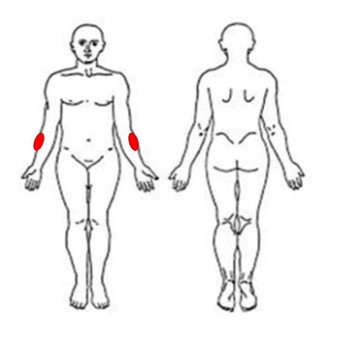
Our understanding of patien's problems:
The presentation suggests a load-induced bilateral elbow pain. potentially pointing towards tendinopathy. This could be resulting from sudden overload followed by prolonged underloading, leading to reduced tendon capacity and increased pain sensitivity.
Psychosocial factors such as fear avoidance and negative beliefs further contribute to symptom persistence. However, confirmation requires correlation with clinical findings, further examination and appropriate investigations.
Physical examination
Observation
No swelling, redness, or deformity
Palpation
Tenderness over the lateral epicondyle bilaterally.
Mobility screening
Overhead flexion mobility is restricted on the right side
Overhead squat- good
ROM analysis
AROM – full range of motion of the wrist joint is painful in all directions.
Stability screening
Break test-
- Wrist extension- weak and painful bilaterally
- Wrist flexion- weak and painful bilaterally
Grip strength- reduced bilaterally
Sensory examination: normal
Special test analysis:
- Cozen’s test: Positive
- Maudsley test: Positive
These positive tests confirm extensor tendon involvement.
Investigation
X-Ray – Normal bilaterally
Differential diagnosis:
Osteoarthritis of the Elbow
- No stiffness,
- No crepitus, or
- Reduced ROM.
Posterior Interosseous Nerve Entrapment-
No Neurological deficit or weakness of finger and thumb extensors and abductor pollicis longus muscles, innervated by the posterior interosseous nerve.
Cervical Referred Pain or Radiculopathy-
- No Radiation of pain from the cervical spine reproduced by palpation and/or active or passive movements of the cervical spine.
- No Focal motor, reflex, or sensory changes associated with the affected nerve
Possible Diagnosis:
Chronic bilateral lateral elbow tendinopathy
with:
- High irritability
- Reduced Load Tolerance
- Psychosocial contributors
Reasons:
- Chronicity of the condition
- Caused by overloading
- Localised pain over the lateral forearm region
- Pain on palpation
- Positive warm-up phenomenon, that is, when pain improves with some movement and worsens on overload.
- Pain is reproduced during resisted contraction and during stretch.
Treatment Planning:
- Patient’s beliefs and expectations- she had a belief that this problem would not be cured, and she had very little expectation of our treatment.
- Overall Treatment Strategy
- Recovery is expected to take ~12+ weeks, depending on load tolerance and progression
- Focus on:
- Load management
- Progressive strengthening
- Functional restoration
- Psychosocial rehabilitation
Pain monitoring model: Acceptable pain ≤ 4–5/10 and should settle within 24 hours
| Weeks | Goals | Exercises |
|---|---|---|
|
1st and 2nd Week (Pain Modulation & Confidence Building) |
Reduce irritability, Build movement confidence, mobility and isometrics |
Wrist mobility, Thoracic extension and rotation mobility, Isometric wrist extension |
|
Week 3 to 6 (Load Restoration) |
Improve tendon capacity – concentrics, eccentric and posterior shoulder strengthening |
Concentric wrist extension, Eccentric wrist extension, Supination-pronation, Wrist curls, Y and T raises |
|
Week 7 to 10 (Functional Strength) |
Restore grip and functional strength |
Suitcase carry, Hand gripper exercise, Reverse curls, Hammer curls, Face pull |
|
11th and 12th Week (Return to Activity) |
Return to ADLs and Upper body exercises |
Dumbbell chest press, Shoulder press, Dumbbell rows, Lateral raise, Bicep curls, Tricep pressdown |
Psychosocial Management
- Address negative beliefs:
“The tendon is not permanently damaged—it has reduced capacity which can be rebuilt.” - Reduce fear avoidance: Graded exposure to movements
- Improve self-efficacy: Track progress (pain, strength, function)
- Sleep education: Emphasise role in recovery
Clinical Summary
This case represents a classic example of load mismanagement in tendinopathy, where a sudden increase in activity followed by prolonged underloading led to reduced tendon capacity.
The persistence of symptoms is further influenced by psychosocial factors, including fear avoidance and low recovery expectations.
A graded loading program combined with education, behavioural modification, and functional progression is essential to restore tendon capacity, reduce pain sensitivity, and rebuild patient confidence.