Contents
INTRODUCTION :
As physiotherapists, we are struggling at some point in rehabilitation to achieve better outcomes, so to address that, we have created a blog series.
After reading these blogs, you will learn how to approach a patient or an athlete with painful conditions, injuries, or post-surgery in the upper limb, and how to manage and progress the patient for a better outcome. These blogs will also be the roadmap for the return to sports.
This blog discusses the initial three months of rehab after injury or surgery, to gain a full range of motion (ROM) with proper care and progression.
EVERYONE COMES FOR THE SAME GOAL BUT DIFFERENT NEEDS.
Consider a 23-year-old male with a diagnosis of acromioclavicular joint separation- grade 2, who underwent nonsurgical rehabilitation. We will approach him with a good understanding of his pain level and fear of movement, providing proper patient education, explaining the natural history of the condition and encouraging him to gain from available to full ROM.
It can apply to all other upper limb conditions like SLAP tear, Anterior shoulder dislocation, tennis elbow, radial head, and humerus shaft fractures.
Patients may come to us immediately after injury, after a few months or years after surgery or injury. In every phase, we have to focus on gaining full ROM, along with reducing pain and swelling, which is the primary goal. Each condition has a different natural history and healing time, so we have different ways to approach each condition according to the level or severity of injury.
When the patient or athlete has any type of injury or problem, understanding the natural history and providing treatment based on their needs and demands, finally directing them toward what they want to achieve, is good rehab.
Someone just what to become pain-free, the other person what to throw, and another person may want to get back to his sports and achieve a previous level of performance. So everyone comes for the same reason (recovery) but with different needs.
| Injury type | Immobilisation / ROM / Strengthening | Return to ADL / sports |
| SLAP tear (Surgical) | 1 – 6 weeks (Gentle passive movement)3 – 9 weeks ( Active ROM slowly progress to strengthening) | RTA 3 – 6 months RTS overhead activities 4.5 – 7months SLAP (surgical) |
| SLAP tear (Non-Surgical) | 0 – 3 weeks(Immobilisation)3 – 6 (Restore pain-free ROM and gentle strengthening)6 – 12 weeks (Increase shoulder strength and endurance) | Prepare sports-specific activities (12 – 16+ weeks)RTS 4 – 6 months SLAP tear (Non-surgical) |
| Anterior shoulder dislocation (surgical) | 1 – 4 weeks (Protect repair)5 – 12 weeks (Gradual restore Full ROM progress to strength) 13 – 21 months (maintain full ROM)Sports-specific training begins – week 20 | RTS 26 – 32 weeks Shoulder anterior dislocation (surgical) |
| Anterior shoulder dislocation (non-surgical) | 0 – 3 weeks sling Immobilisation (Gentle ROM)3 – 6 weeks ( Restore full ROM and begin strength training)6 – 12 weeks (enhance strength and endurance) | RTS 12+ weeks Shoulder anterior dislocation (non-surgical) |
| humerus head fracture | 0 – 4 weeks (Immobilisation)3 – 6 weeks ( Achieve near full ROM)6 – 12 weeks ( Full ROM and strengthening)Based on the fracture and its type, management can change | RTS 12+ weeks Proximal humerus fracture |
| Humeral Shaft fracture | 0-6 weeks (Immobilisation)6-10 weeks ( Gentle ROM Restore)10-16 weeks (rebuild strength)Based on the fracture and its type, management can change | RTS 16-24 weeks (Restore power and sports-specific motion)6 TO 12 months (safe return to competition)Humeral Shaft fracture |
| TFCC (Triangular fibroCartilage complex) injury | 6 weeksBased on the fracture and its type, management can change | RTW: After 10 weeksRTS: After 12 weeks TFCC |
TABLE 1: Natural history and return to sports data for common upper limb injuries.
Not everyone will follow the same path as mentioned above; it varies depending upon:
1. Level of sports
2. Training experience
3. Pain level/tolerance
4. Fear of apprehension (shoulder dislocation)
5. Level of injury
6. Confidence and attitude of the person
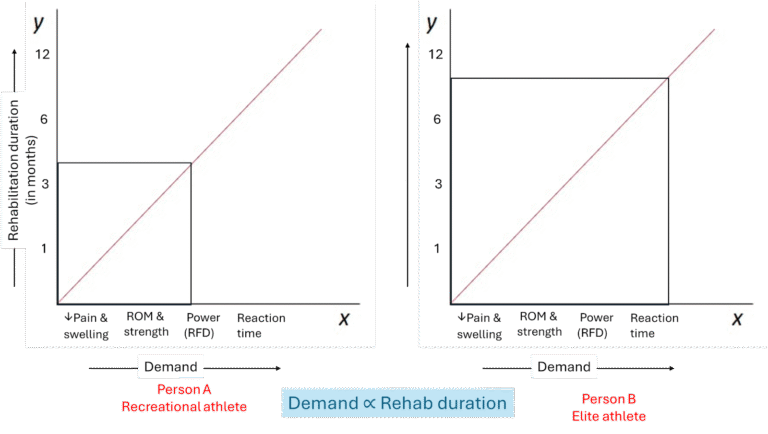
DEMAND VS. REHAB TIMELINE

Note: This is a sample chart to show that the timeline varies from person to person depending on the above-mentioned factors.
Rehabilitation duration changes based on the physical demands of the individual.
Person A (Recreational athlete):
- The sport/activity demands are lower.
- Once pain & swelling reduce and basic ROM + strength return, they can often return to activity → Shorter rehab duration
Person B (Elite athlete):
- The sport requires higher levels of ROM, strength, power (RFD), and reaction time.
- As the performance demands are greater, they need to progress further along the rehab continuum before returning to sport → Longer rehab duration
Rehab duration is proportional to task/athlete demand. Higher-demand athletes require more advanced qualities before returning. Thus, rehab takes longer.
HOW TO START THE REHAB

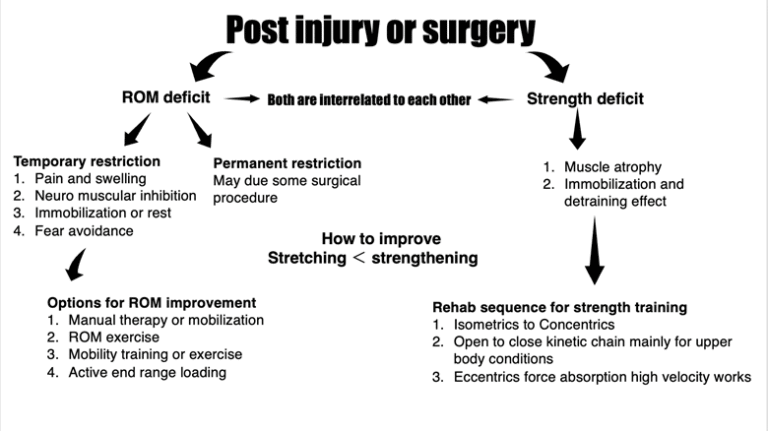
In flow chart 1, we have explained that in post-injury or post-surgical situations, loss of ROM and strength is a big culprit for limitation in functional activity, reducing the quality of life.
A simple way to improve range of motion is stretching (as we all know), but resistance training with external load offers dual benefits by improving ROM as well as strength gain. However, the therapist should know how to adjust the load, how to progress and regress the exercise based on the client’s movement experience.
Multiple high-quality evidence syntheses like (Alizadeh et al., 2023), (Afonso et al., 2021), (Rosenfeldt et al., 2024), (Favro et al., 2025) suggested that resistance training using external loads and through full range or near full range improves ROM.
ROM gains are not limited to stretching; full-range, loaded resistance training can improve mobility while simultaneously enhancing strength and control. This makes Resistance Training a more functionally efficient strategy for athletes who need strength at end-range, not just passive motion.
PHASED REHABILITATION PROTOCOL- first 3 months
| Phase | Duration | Goal | Target |
| Phase 1 – Acute | 0-2 weeks | • Reduce pain & inflammation • Protect healing tissues • Maintain mobility | • Pain controlled • ≥ 50–60% pain-free ROM |
| Phase 2 -Intermediate | 2-6weeks | • Restore full pain-free ROM • Begin strengthening • Improve scapular control | • Strength ≥ 70% • Able to perform pain-free resisted movement |
| Phase 3 -Strengthening | 6-12 weeks | • Build strength & endurance • Restore dynamic stability • Introduce plyometrics & functional tasks | • Strength ≥ 85% contralateral limb |
Phase duration and goals may vary depending on the condition and individual response. Rehabilitation is multifactorial and patient-specific. Look at the targets. Once the patient or athlete achieves the target, move to the next phase of rehabilitation. It may not be standard for 0-2 weeks for everyone. This table is only an example framework.
IMPORTANCE OF AEROBIC FITNESS
Aerobic fitness is important in the initial phase of rehab because it prevents deconditioning, helps in supporting a return to sports demands in a systemic way, and improves the healing timeline.
Overhead throwers, swimmers, and racket sports require aerobic fitness for performance enhancement. A simple way to implement is running and non-arm-supported cycling, which helps to maintain the aerobic fitness VO2max.
In all three phases of rehabilitation, exercise and its progression are explained in this video.
LEARNING FROM THIS READ
- Rehabilitation must be personalised — each individual’s goals, demands, and response guide the journey.
- Early priorities remain universal: calm pain, restore mobility, and rebuild confidence.
- Full-range resistance training is a cornerstone, improving both ROM and strength more effectively than stretching alone.
- Rehab timelines scale with demand: higher-level athletes require greater strength, power, and reactivity before returning to sport.
- Recovery follows a simple progression: pain control → mobility → strength → functional capacity → performance.
- Maintaining aerobic fitness is essential to limit deconditioning and support return-to-sport readiness.
WHAT IS NEXT?
Once your patient or athlete has achieved 80% of strength or more, then progress to work on power, Rate of force production and throwing, which are clearly explained in upcoming blogs.
Azarudheen is a passionate physiotherapist and exercise prescriptor with a deeply rooted belief in the transformative power of movement and education. His journey began in 2013 as a first-year physiotherapy student, balancing academics with part-time work to support his ambitions. Early in his career, he sought practical experience and began working at a fitness center, eventually transitioning into roles that expanded his knowledge and skill set in both clinical practice and teaching.
Driven by a relentless curiosity and desire for growth, Azarudheen took on an anatomy tutor position, believing in the value of continuous learning. A pivotal turning point came with his experience in cardiopulmonary rehabilitation at PSG Hospitals, where he worked closely with lung transplant patients. This experience emphasized the life-changing impact of functional movement and patient education, inspiring him to dive deeper into respiratory and cardiovascular physiology.
With strong support and belief in his vision, Azarudheen pursued a Master’s in Exercise and Sports Science at Manipal University—choosing it over conventional MPT programs to focus more on biomechanics, exercise physiology, strength and conditioning, and lifestyle health. His dedication was evident as he spent late nights at the library, worked part-time in gyms and cricket academies, and honed his craft through practical application.
In 2022, despite initial doubts, he opened his first clinic in his hometown—an act of courage and self-belief supported by his family and mentors. Built from the ground up, this clinic marked the start of a new era. Today, Azarudheen leads a growing team of 21 physiotherapists across two thriving clinics in Chennai and Coimbatore. His philosophy centers on patient education, movement optimization, and professional growth, and he continues to evolve both as a clinician and a leader.
Azarudheen’s journey reflects the power of perseverance, vision, and lifelong learning. He is not only a practitioner but also a mentor and advocate for a more thoughtful, movement-centered approach to healthcare.