
THE REHAB ROADMAP OF LOWER LIMB INJURIES

Introduction:

It’s a familiar scene for physiotherapists: a patient walks in with a painful limp after a lower-limb injury—worried, confused, and eager to return to normal life

Although such cases are frequent, each rehabilitation journey is unique and rarely follows a linear path. Timelines, symptoms, and goals vary widely. Some seek physiotherapy immediately after an injury or following surgery, while others come later when daily activities become difficult. For some, the goal is returning to sport; for others, it’s simply moving without pain.

The Lower Limb Rehab Series:

Our role as physiotherapists is to guide each individual through a personalised rehabilitation plan. Yet, it’s normal for clinicians to wonder: Where do I begin? What comes next? Why isn’t there progress?

To address this, we’ve developed a Rehab Series as a guide to approaching patients from the early recovery phase to return-to-sport readiness.

Note: This series is not a fixed protocol but a guide to help you with the rehab journey step-by-step.

This blog of the rehab series focuses on the initial three months of rehabilitation, emphasising restoration of normal function through a full range of motion (ROM) and adequate strength.

Common lower limb injuries and their Natural history:

Understanding the natural healing course of each condition helps clinicians set expectations and plan rehabilitation appropriately.

Condition Weight-Bearing (WB) Return-to-Sport (RTS)
ACL injury / ACLR Early WB helps outcomes but may increase laxity; progress as tolerated. (1) ~9–12 months (2). Should be criterion-based, not time-based. (3)
Ankle sprain / chronic instability Acute: WB as tolerated.
Post-op: WB varies 0–6 weeks.
Sprain: 2–6 weeks.
Stabilisation surgery: 8–16 weeks. (4)
Ankle fracture (operative) Early WB (immediate–2 weeks) in stable fixations. (5) Months; depends on fracture and sport demands.
Meniscal repair / meniscectomy Repair: Partial WB – 1 week.
Full WB: 4–6 weeks. (6)
Meniscectomy: Early WB.
RTP: 3–6 months; longer (6–9+ months) with ACLR. (6)
Patellofemoral pain (PFPS) No WB restriction. Rehab/load-based progression. Symptoms resolution: 6–12 weeks; RTS based on symptoms. (7)
Tibial shaft fractures Early WB (<6 weeks) in stable fixations. (8) Variable: 3–12 months depending on healing & treatment type. (9)
Stress fractures NWB or reduced load initially; gradual progression. (10) Low-risk sites: 6–12 weeks; high-risk sites: longer. (11)
Total hip arthroplasty (THA) Early protected WB; pain-guided progression. Full WB: 4–6 weeks. (12) Recreational: 4–6 months.
Professional: 12–15 months. (12)
Total knee arthroplasty WB as tolerated immediately. (13) Low-impact sports: TKA – 13 weeks, UKA – 12 weeks. (13)
High-performance: delayed RTS.
Achilles rupture / repair Early mobilisation + progressive WB.
Partial WB: 2 weeks; Full WB: 6–8 weeks. (14)
RTP: 3 months; RTS: 6–9 months. (15)
Hamstring strain WB allowed; load and eccentric-focused rehab. (16) ~3 months; healing is not time-based. (16)
Hip labral tear / arthroscopy Early WB as tolerated for most procedures. (17) RTP: 3 months; RTS: ~4–9 months. (17)

Factors influencing rehab:

As mentioned earlier, rehab is always unique for each individual. It might differ depending on factors like: 

  • Level of sports 
  • Training experience 
  • Instability 
  • Pain level
  • Level of injury 
  • Confidence and attitude 
  • Needs and goals  

If  you’re thinking about how these factors influence the methods and duration of the rehabilitation, here’s an example: 

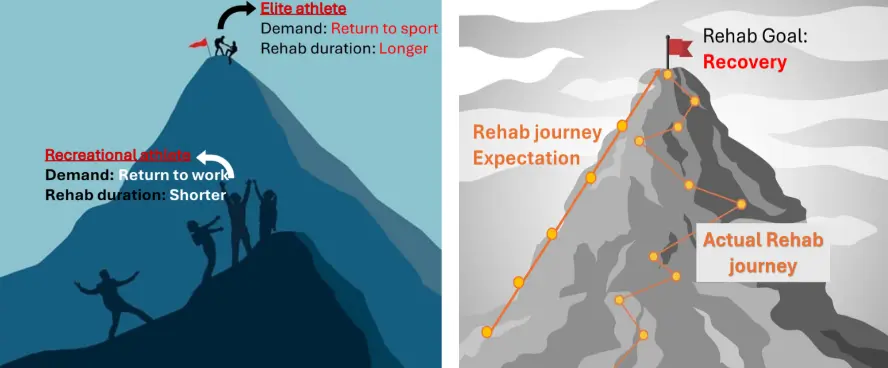
Consider a recreational athlete/general population and an elite athlete to have the same injury- ACL injury. Let’s compare their rehab journey.

rehab goal

Rehab is like Mountain climbing

  • A recreational individual is like a tourist climbing a small hill. Their goal is to return to daily routines and work.
  • An elite athlete is like a professional climber ascending a much higher peak. Their goal is high-level sport performance.

The higher the peak, the tougher and longer the climb. Similarly, greater physical demands require longer, more detailed rehabilitation.

What to focus on- initial 3 months:

The early phase lays the foundation for everything that follows. Key priorities include:

  • Reduce Pain & Swelling
  • Restore Range of Motion (ROM)
  • Build Baseline Strength
  • Maintain Cardiorespiratory Fitness

Let’s break these down.

Reduce pain and swelling:

Pain and swelling are common after most lower-limb injuries and can significantly limit mobility and confidence.

Pain ≠ Damage

Pain is influenced by:

  • Fear
  • Anxiety
  • Attention
  • Past experiences

Helping the patient understand this reduces fear and promotes early movement.

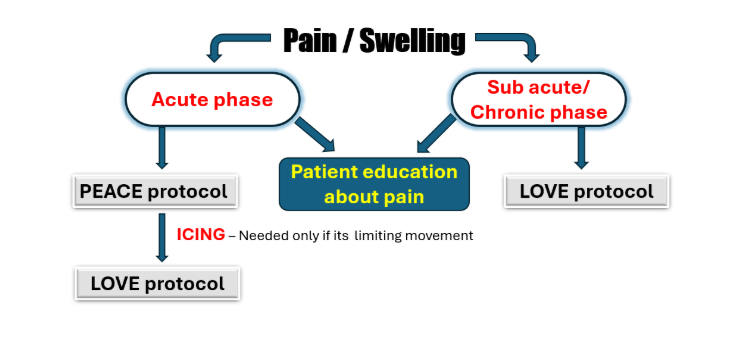
pain and swelling

PEACE & LOVE Framework

This approach helps manage acute symptoms:

PEACE

  • P – Protection
  • E – Elevation
  • A – Avoid anti-inflammatories
  • C – Compression
  • E – Education

LOVE

  • L – Load
  • O – Optimism
  • V – Vascularisation
  • E – Exercise

When Pain and Swelling are severe in pre-operative phases or when symptoms restrict any movement:

  • Short-term ice or elevation can help reduce swelling
  • Gradual reintroduction of movement remains essential
  • Early mobility increases blood flow and reduces symptoms

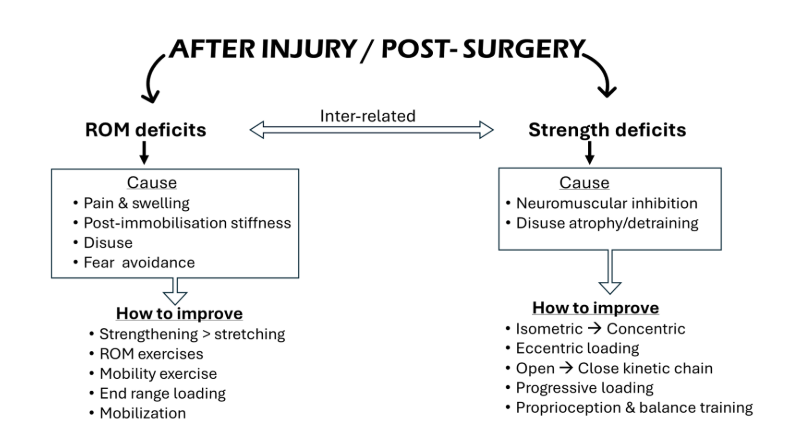
Restore Range of motion:

Early ROM prevents stiffness, reduces compensatory patterns, and prepares the limb for strength work.

  • Focus on achieving pain-free flexion and extension
  • Restore joint-specific ROM (e.g., ankle dorsiflexion, hip rotation)
  • Use movement variability to reduce fear and improve confidence

ROM recovery is a key milestone before progressing into advanced strength phases.

Build Baseline Strength

  • Strength provides the mechanical support and functional capacity needed for higher-level activities.
  • Focus on training: Quadriceps, Hamstrings, Gluteus, Calf complex, Core & trunk stabilisers
  • Early strength work should be simple, controlled, and progressive, gradually shifting from open-chain exercises to more functional, weight-bearing tasks as tolerated.

Maintain Cardiorespiratory fitness:

This is often overlooked but is critical for whole-body recovery. Lower-limb injuries often limit walking or running, leading to rapid deconditioning. 

Maintaining aerobic capacity:

  • Enhances blood circulation
  • Improves tissue healing
  • Preserves performance in athletes
  • Supports faster return to work for the general population

Options When WB Is Restricted

  • Upper-body ergometer
  • Swimming or pool walking
  • Cycling (if tolerated)

As recovery progresses, aerobic training can be integrated into functional, whole-body exercises.

Main takeaway learnings:

  • Consider the natural history of injury.  
  • Everyone’s rehab journey is unique- Timelines and methods vary for each person, depending on factors like level of sports, type of injury, needs, demands and mindset of the person. 
  • Rehab has to be personalised and should focus on the patient’s goals (e.g., return to sport vs. daily activity).  
  • Foundation is the same: ↓pain & swelling, ↑ROM & strength, maintain cardiiorespiratory fitness.
  • Keep it simple: pain control → mobility & strength → functional capacity → performance & sports readiness.

The next step: 

Once your patient or athlete has achieved good ROM and strength (Limb Symmetry Index), progress to work on power and rate of force development, and return to sports, as explained in the upcoming blogs.