EXPLORE LOAD & CAPACITY: LOADING TOO MUCH, TOO SOON
Patient profile
- Age and gender:32 years female
- Occupation: Homemaker
- Complaint: Low back pain
Past History:
In July 2024, she was hopping continuously for five floors on the stairs, and the next day, she developed severe pain in the lower back area. She took some pain-relieving measures (like Topical Analgesics, Hot compression). Afterwards, even a small jerky movement led to pain. But she managed somehow.
In September 2024, her lower back pain increased, so she went to the hospital and the Orthopaedic doctor said not to bend forward and not to lift heavy weights. She followed the instructions, but pain was there intermittently.
After a few days, she noticed that she was shifting the weight to one side while sitting, so she couldn’t sit without support for long periods. Additionally, she found it difficult to lie on a hard bed. In January 2025, she lifted a heavy glass table, which was about 70 kg; after that, the pain increased.
She avoided any sort of physical activity and became more sedentary because of the fear of aggravating pain and the doctor’s advice to avoid certain movements. She’s very stressed as she’s planning her pregnancy and worried that this pain might be a problem.
Physical activity status:
After the onset of pain, she has been completely sedentary by avoiding many activities, such as forward bending and lifting heavy weights.
Sleep:
She does not sleep well, averaging only 5-6 hours of sleep every day.
Stress:
She has more stress because she worries about her pain and its impact on her everyday life.
Pain Analysis:
- Intensity: 5/10
- Aggravating factors: Sitting without back support, lifting weights, travelling long distances, and any jumping activities.
- Relieving factors: Rest, painkillers, and hot packs.
- Location: Left side, Lower back
- Duration: one year (Chronic)
- Type of pain: Nociceptive
- Character: Intermittent, sharp pain.
- Irritability: Moderate (pain starts gradually while lifting a heavy object, jumping activity)
- Sensitivity: Moderate (with rest, the pain subsides)
- Lifestyle impact: High impact, because she can’t bend forward and can’t be involved in day-to-day activities.
- Fear of movement analysis: present, she has a fear that bending forward or lifting weights might worsen her pain, as the doctor suggested avoiding those activities.
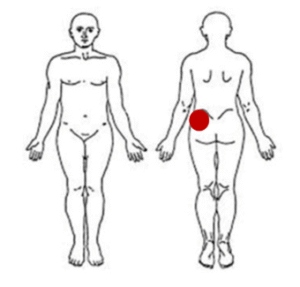
Understanding the patient’s problem, based on history and pain Analysis:
Excessive and unaccustomed load caused the pain, and factors like inadequate sleep, fear of movement, and lack of physical activity aggravated the pain. She did not undergo proper rehabilitation, which led to chronicity. Pain is probably due to overload. However, further examination is needed to rule out other serious or nerve-related pathologies.
Physical Examination:
Observational finding:
No visible changes like swelling, redness, bruising, muscle atrophy or hypertrophy.
Range of motion (ROM) Analysis:
No restriction in ROM in the Hip & knee joints while comparing both sides.
Mobility:
Overhead squat: Limited (shift towards the right side)
Forward flexion: forward flexion is reduced and can only reach above the shin level.
Strength test:
Isometric break test of the left side hip abductor, adductor and hamstring was weak, pain-free.
| Strength test | Right side | Left side |
|---|---|---|
| Hip flexor | Good | Good |
| Hip Abductor | Good | Weak Pain free |
| Hip adductor | Good | Weak Pain free |
| Hamstring | Good | Weak Pain free |
Palpation:
Pain on palpation over the left side glute region.
Special test:
SLR, crossed SLR, and Slump test are all negative
INVESTIGATION:
- X-ray – Normal
- Blood test /MRI/US – No other investigation was taken.
DIFFERENTIAL DIAGNOSIS:
SI joint dysfunction:
- Pain was unilateral, but there was no pain radiating to the buttock, hip or thigh
- No Morning stiffness is present in the hip or lower back
Lumbar radiculopathy:
- No neurological symptom is present.
- SLR, Crossed SLR, and the slump test are negative
Severe spinal pathology:
- No history of fracture, infections, cauda equina syndrome, or severe spinal degeneration.
DIAGNOSIS:
1. What is the patient's perception of pain?
She has the wrong understanding of her pain, that certain movements should be restricted as they might trigger her pain more; so, we need to guide her and do proper rehab exercises.
2. Psychosocial Factor Analysis
Cognitive: Mildly affected – she believes pain will be induced by forward bending.
Affective: Severe affected – she was worrying that her pain might be a hindrance to her pregnancy, as she’s planning for a baby.
Social: Mildly affected
3. Belief and expectations:
She believes that if she bends forward, the pain will come, and she expects to be pain-free when bending, sitting for long periods without support, and lifting weights.
4. Possible diagnosis:
Load-induced pain because she was hopping continuously on five floors, lifting weights beyond her capacity and also sitting for a prolonged time.
NON-SPECIFIC LOW BACK PAIN– Due to sudden overload and a sedentary lifestyle
- Psychosocial factors were affected. She was stressed as she avoided movements essential for daily activities, as suggested by the doctor.
- The stress factor is higher because she is worried that this pain might cause problems during her future pregnancy.
TREATMENT PLANNING:
Goal: She wants to get stronger and have a pain-free life.
- How long will it take? It might take approximately two months.
- Things to focus on during treatment:
- Patient education
- Lifestyle advice
- Strength training
Patient education: First, focus on patient education (because she has a wrong understanding of her condition)
- We need to guide her, how to improve a healthy lifestyle, also follow the sleep pattern, 3-4 litres of water intake and reduce stress.
- Improve her capacity to tolerate the pain.
- Teaching about load management.
- First start GRADED EXPOSURE (rehab phase), and after we focus on TRAINING PHASE (strengthening exercises).
|
REHAB PHASE (GRADED EXPOSURE) Load ≤ capacity |
|
|---|---|
| Duration | Sample exercise program |
| Week 1 & 2 |
Mobility exercise: supine scorpion, prone scorpion, cat and camel, child pose to cobra. Strengthening exercises: Bridging, curl up, dead bug, clam shell, wall squat, Hamstring curl, calf raise, shin raise. |
| Week 3 & 4 |
Mobility exercise: 90- 90, aeroplane, Hip flexor mobility, frog mobility Strengthening exercises: Hip thrust, RDL, Hamstring bridging, fire hydrant, squat. |
|
TRAINING PHASE- GRADED ACTIVITY Improve Capacity |
|
|---|---|
| Week 5 & 6 |
1. Deadlift 2. Sumo squat 3. Leg extension 4. Jefferson curl 5. Banded Rotational |
| Week 7 & 8 |
1. RDL, single leg RDL 2. Single-leg bridging 3. Single plank leg lift 4. Single-leg calf raise 5. Side plank clam shell |